
Soaponomics: Unraveling the Economics of Crafting Natural Soap


A. Introduction
Have you ever considered the costs behind soap production ? When asked, most people have minimal knowledge of the primary ingredients used in natural soap production (spoiler alert: oils and butters). This may seem perplexing at first, but natural soap really cleanses from the ingredients it is produced with!
By soap making, we mean natural soaps (a combination of oils, lye water, natural colors, and essential oils), not synthetic detergents derived from petroleum (a.k.a. your old favorite shower gel or €0.89 bar of "soap"). Our transparent pricing policy may be of interest to you as well:
- as a consumer, to grasp the cost of soap adoption;
- as a fellow soap producer, to compare to your own costing
When we first launched babassu soaps, we had no concept about the investment required to sustain a soap-making business because it was just for fun. We had no idea about certificates, insurance expenses, or German bureaucracy. However, we believe that if we had known everything beforehand, we would not have established our firm. But we persisted, and now we're not ready to back down after putting in so much work to make it happen!
B. What needs to be considered when setting the price for your soap ?
We can divide our business costs into two clear groups. First, the variable expenses directly proportional to operations:
1. Raw materials 2. Equipment & operating supplies 3. Salary 4. Rent 5. Packaging
Second, the structural fixed costs. These are your primary levers for increasing margins via production scaling, as higher output results in a lower overhead cost per individual soap bar:
6. Certification 7. Insurance 8. Marketing presence
1. Raw Materials
The price here can vary substantially based on the thing you wish to sell. The cost of manufacturing natural soaps utilizing the cold process is broken down below. This argument does not entirely apply if you use a different approach. Glycerin soaps (melt casting), for example, or syndet (solid detergent bars made from petroleum-derived chemicals).

Main ingredients prices ranges (averages 2022): - 9-30€/kg for quality organic vegetable oils - 140-350€/kg for essential oils - 15-80€/kg for natural colorants - 6€/kg for NaOH - 1€/kg for distilled water in Germany
These rates are based on previous experience with babassu soaps. Of course, if you buy in greater quantities or in different quality, you can discover lower pricing on the market.
After 3 months (exception: 100% olive oil soap: at least 1 year), natural soaps are fully hardened and crystalline, allowing superfluous water to evaporate and the crystalline structure of the soap to form properly. We also removed the rough edges for a more attractive display and a more pleasant experience during the initial applications. We receive soap scraps in this manner, which we then convert into fresh soaps (for personal use only, not for sale online).
2. Equipment

One time investment, such as a precision scale, various soap molds, hand mixers, laboratory furniture, soap cutters, cooking pots, gloves...
A lasting term should be estimated for each item to comprehend its impact on the price of a batch of soap. Each soap mold, for example, could withstand 200 batches, or a precision scale could last ten years (= x batches)...
Total investments as of June 2026: €1,350 over the past 7 years of operation, modeled over a total 10-year lifecycle. This averages out to approximately €0.27 per soap bar (based on an average production of 500 soaps per year over a 10 year equipment lifecycle).
production & operating supplies such as cleaning and disinfecting products, energies, water...
Our calculations gave an additional estimate of 0,02€ of energy and water consumption per soap.
3. Salary
We are delighted to bring authentic and high-quality natural soaps to the market! Although it's just a hobby for us and we'd like to keep it that way, the time required for preparation, production, and cleaning, along with the high costs, make it challenging to sustain the operation. We compensate ourselves at 14.6€ per hour, which is the minimum wage in Germany.
4. Rent

Our laboratory's soap storage area is approximately 1,5 m2. The storage time is estimated at 6 months (3 months of cure and 3 months before sale) and costs approximately 32€ per month.
Rent for 6 months = 192€
Divided by 250 (500/2) --> 0,77€ per soap
5. Packaging

individual paper bag about 0,12€
cardboard
personalized ID card for each soap as packaging (ingredients list...), about 0,12€
some paper filling
branding material (tapes, laser engraving printer...)
Total estimation of 0,34€ per soap.
6. Testing and certifications

In Europe, every single recipe needs to be approved by a laboratory. This differs from the US approach, where liability insurance absorbs the risk in case of product issues. in EU both are needed :) Testing a recipe costs from 250€/350€ depending on the laboratory provider.
7. Insurances
Many insurance companies have for different quotations and coverages. And they surely have their juicy prices. Our activity yearly coverage is 275€ per year. It covers mainly product liabilities, production place hazard.
8. Marketing

Online - having a domain and webshop is 30€ per month. Offline - being physically present at fairs, markets. 5-6 times a year about 400€ fees
C. Costs summary
These summaries were created to help you comprehend our previous discussion. For consistency, all calculations start with 1 kilogram of soap production and are then broken down to a single soap bar. After curing, soap loses 10% of its weight, with an additional 8% lost during the beveling process (soap scraps are recycled for personal use). The calculations assume an annual production of 500 soaps, each weighing 100g after curing. The equipment is expected to last ten years.

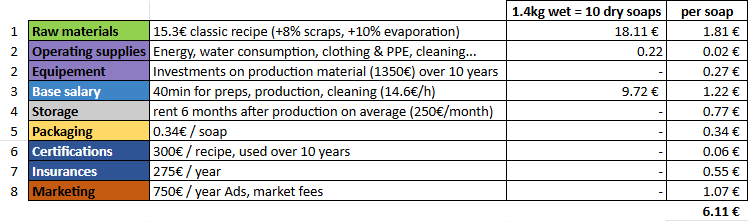
Margin Calculation:
Gross Profit = Retail Price - Production Cost = €8.90 - €6.11 = €2.79
Gross Margin = (Gross Profit / Retail Price) × 100 = (31.4%)
At our current micro-scale, utilizing our premium ingredient policy and manual branding methods, a natural soap bar must be sold at a minimum price of €8.90 per 100g to maintain a basic 31.4% gross margin.
This margin improves when scaling from a 10-soap batch to a 40-soap batch. By optimizing production workflow, setup times, and cleaning efficiency, the labor cost per bar drops. This reduces the total production cost by €0.91, bringing it down to €5.20 per bar.
New Margin (40-Soap Batch): €8.90 - €5.20 = €3.70 profit (41.6% margin). While this is a clear improvement for a dedicated hobbyist, it is still below the 60% to 70% gross margins required to run a commercially viable, scalable business.
D. Discussion margin/quality
Operating at a 30-40% gross margin allows us to sustain this activity as a self-funding hobby, ensuring we can replace worn silicone molds, gloves, or pipettes. However, as noted in our cost summary, true commercial viability requires moving closer to a 60% gross margin. To achieve this without compromising our values, we must look closely at our pricing rules and scalability structures.
This thin baseline margin explains why we do not offer special discount pricing for Black Friday or Christmas; for a micro-scale project, our price-to-quality ratio is already at its absolute limit.
In cosmetics business courses, the standard rule of thumb is to apply a 100% markup on all combined material costs and wages (known as Keystone pricing) to form a wholesale price, then double it again for retail.
For our specific formula, prioritizing certified organic ingredients would force our retail price up to €12–€13 per bar. This exceeds what our core target market, environmentally conscious skincare enthusiasts aged 20–65, is typically willing to pay for a daily-use item.
Why can I find natural soap for less than 5€/100g on the market ?
A non-hobbyist would have to really consider how to decrease costs while (hopefully) maintaining as many of the ideals they stand for as feasible. And there are as many strategies as there are soap companies. The following are the most critical leverages:
--> Raw materials
having average to poor ingredients qualities. With a 'good' marketing strategy, some companies can hide this fact.
Using perfumes instead of essential oils, or not using scent at all.
Purchasing in bulk (larger company). If your production exceeds approximately 5000 soaps, you can produce a quality soap for 3.5-4€, but this moves you away from the artisanal crafting process.
--> Equipment Having uncomplicated or no designs (= less time spent in production)
--> No insurance A decision in term of risk management
--> Salary
Willingness to labor for less or "for free" or simply having a simple / no design (= less time invested in the production process)
--> No certification One soap a day keeps the authorities away ? 🍎
--> Rent "Go big or go home", an increase of production reduces overall costs. We clarify this point below chapter
--> Marketing / Packaging This part is the favorite one from big corporation to play with. Check our marketing / greenwashing myths.
The immense influence of marketing can persuade you to purchase a product solely because of its packaging.
Greenwashing is a marketing tactic that exploits consumers' lack of knowledge about true sustainability.
E. Projection in time
For the sake of the exercise, we applied the same analysis with the following conditions (many ifs) to see how the costs would change:
we do not relocate (rent stays the same, accumulating storage)
production is raised to 500 to 5000 soaps
no hiring
no rise in marketing expenses
maintaining the same recipes
Starting at 5000 soaps, raw material costs also begin to decrease as you buy in bulk (replaced 15.4€ by 14€). This provides even more opportunities to increase profit margin while maintaining the usual price with the same quality.


If we manufactured 5,000 soaps annually at our current retail price of €8.90, our gross revenue would exceed the €22,000 Kleinunternehmer threshold. Consequently, we would lose our VAT exemption, forcing us to register as a regular business and add 19% VAT to our prices. To remain safely under the VAT threshold while operating as a small-scale hobbyist, the optimal sweet spot is producing between 2,000 and 2,400 soaps per year.
F. Conclusion
To offer a lower, more competitive price to soap enthusiasts, many commercial brands make compromises on ingredient quality. However, our strategy is exactly the opposite: we refuse to compromise on our raw materials. We strive for absolute quality (a professional standard carried over from my primary career) and are dedicated to soap-making education. In other words, we will not change our high standards!
With our current size in 2026 and the investments made/price policy, we are able to continue producing but not generating significant profits. If you want the most economical high-quality natural soap, go no further than babassu soaps ;)
While scaling our production to several thousand bars per year would lower our raw material costs through bulk purchasing, scaling significantly past that point would change the nature of the business. Moving into mass distribution would require commercial manufacturing equipment and automated wrapping systems, moving us away from the traditional, small-batch cold process method that defines true artisanal crafting. We choose to stay small, intentional, and entirely handmade.
We hope you found this information to be useful!

Comments