
Fact vs. Fear: The Truth Behind "Free-From" Cosmetic Claims

Updated: Feb 8

TL;DR
Many "free-from" claims are marketing tactics designed to exploit "chemophobia" rather than enhance safety. While "chemical-free" is a scientific impossibility, understanding the legal landscape (EU Regulation 655/2013) and learning to read the INCI list will help you distinguish between genuine allergen avoidance and shifty marketing distractions.
Introduction: The DHMO Incident
Are you familiar with the DHMO (DiHydrogen MonOxide) incident?

For years, activists have warned of a hazardous chemical called DHMO. They claim it is a major component of acid rain, can cause severe burns in its gaseous state, and is used as a coolant in nuclear reactors.
The twist? DHMO is simply the scientific name for water.
This classic hoax illustrates how easily scientific information can be twisted to create fear. In the cosmetics industry, this is often called "Chemophobia." If a brand tells you a product is "chemical-free," they are being dishonest. Water, essential oils, and your own skin are all made of chemicals. Everything you can touch or smell is a chemical; there is no such thing as a "chemical-free" cosmetic.
In this guide, we explore the psychology and science behind free-from cosmetic claims to help you look past marketing hype and understand what is actually in your products.
The Problem with "Chemical = Bad"
The term "chemical" has been demonized in marketing to imply a substance with a guaranteed negative effect. However, in science, the dose makes the poison. Consider our water example:
It is a corrosive chemical (it rusts metal).
If you drink it in too large quantities, you can die (hyponatremia).
It contributes to the greenhouse effect and is used in nuclear reactors.
We don't ban water because we understand its context. We must apply that same critical mind to our skincare.

The "Free-From" cosmetic claims prayer: Truth or Distraction?
Paraben-free, silicone-free, soap-free... You have probably read one of these "prayers" on a package before. To the average consumer, these claims act as a shorthand for safety. But in reality, this is often the art of professing a truth to hide irresponsible behaviors.
Since 2019, these claims have been more strictly regulated, but they still dominate the internet. In the minds of consumers, a product "free of harmful substances" appears as a positive. But we must ask: How relevant are these claims?
Not All Family Members are Equal
Chemicals in cosmetics are often grouped into "families" like parabens, silicones, or sulfates. It is vital to remember that not all members of these families are equal.
The Paraben Family: While some long-chain parabens are restricted, short-chain parabens (like Methylparaben) are some of the most studied and safest preservatives available.
The Silicone Spectrum: Labeling a product "silicone-free" treats a diverse family of ingredients, some heavy, some volatile and breathable, as a single villain.
The Legal Reality: EU Regulation No. 655/2013
In the past, brands used "Free from X" to make X look dangerous. Today, the legal landscape has shifted. According to EU Regulation No. 655/2013 and the 2017 Technical Document on Cosmetic Claims, these claims must meet specific criteria:
Truthfulness: You cannot say "free from preservatives" if the product contains "multifunctional ingredients" that act as preservatives.
Honesty (Nonsense Claims): You cannot claim "free from mercury" because mercury is already banned by law. Furthermore, you shouldn't claim "silicone-free" on a toothpaste if silicones were never relevant to that formulation in the first place.
Fairness: Claims should not disparage ingredients that have been proven safe by regulatory bodies. The EU considers many "free-from" claims to be "unfair competition" because they create unnecessary fear.
When the Claim is "Shifty": The Preservation Paradox
When a brand brags about what is not in the bottle, they rarely brag about what they used instead. This leads to the Preservation Paradox.
To satisfy the "Paraben-free" trend, manufacturers often switch to less-studied preservatives. These alternatives may actually have a higher rate of skin irritation or allergic reactions than the parabens they replaced. If the marketing were honest, it might read: "We are removing this substance because of bad publicity and replacing it with a controversial substance that hasn't received special attention (yet)."
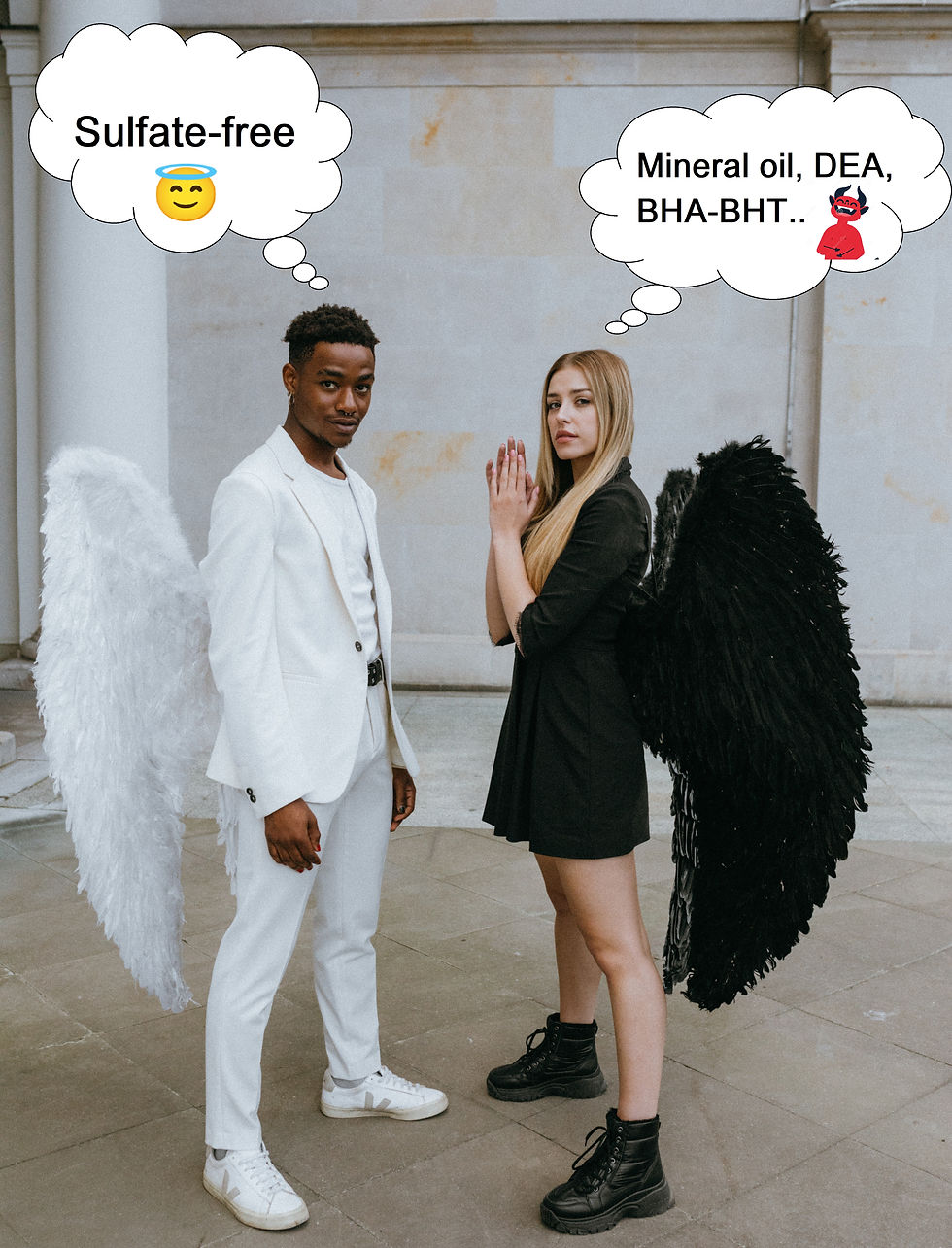
When an ingredient hides others, check the list for:
Doubtful preservatives (like Methylisothiazolinone or Phenoxyethanol).
Mineral oils used as cheap fillers.
Ethoxylated surfactants that might be "sulfate-free" but carry other environmental concerns.
When "Free-From" Actually Matters
Is every "free-from" claim bad? No. They are essential tools when used for the right reasons:
Medical Allergies: If you are allergic to Methylisothiazolinone (MIT), these labels help you stay safe.
Ethics: For vegans, "free from animal-derived ingredients" is a vital ethical guide.
Specific Needs: "Fragrance-free" is crucial for those with sensitive skin, as "Unscented" products often contain masking scents to hide chemical odors.
Checklist: How to Read Labels Like an Expert
Don’t let the front of the bottle do the talking. Follow these three steps:
The "Top 5" Rule: The first five ingredients usually make up about 80% of the product. If a "hero ingredient" is listed after the preservative (usually at the bottom), it’s just marketing "fairy dust."
Identify Multifunctional Ingredients: If a product says "Preservative-free" but contains Pentylene Glycol or p-Anisic Acid, it is being preserved by ingredients not "legally" classified as preservatives.
Use a Neutral Database: Check the INCI list against resources like EWG or Incidecoder to see the actual function of an ingredient rather than the brand's story
FAQ
Q: Are parabens actually dangerous? A: Regulatory bodies (like the SCCS) have cleared specific short-chain parabens as safe. The "Paraben-free" movement was largely sparked by a single, widely misinterpreted study from 2004.
Q: Why do brands still use these labels if the EU discourages them?
A: Because fear sells. Consumers have been "trained" to look for these labels, so brands continue to use them to remain competitive, even if the claims are scientifically "thin."
Q: Is "Natural" always better?
A: Not necessarily. Toxicity depends on the molecule and the dose, not the origin. Many natural essential oils contain more allergens than synthetic alternatives.


Comments